Shortlist.
Know every roster lender's answer before you submit.
Enter the borrower once. Shortlist runs the qualifying income, the stress test, and the debt ratios, then shows you which lenders pass the file, at what rate tier, and the exact number that decides each one.
AdjudicationDeterministic + cited
Stress testOSFI, verified
Your dataStays in your browser
RosterRecomputes live
Watch it work
See a file get adjudicated.
90 seconds, real product, no slides.
The file you know
There is no computational answer to the first question of every deal.
- 01
The borrower is profitable in real life but awkward on paper, self-employed, or carrying rental income, and every lender treats that differently.
- 02
You run the same qualifying math in your head or a spreadsheet, lender by lender, checking stress-test rates and debt ratios against rules you're carrying from memory or an old rate sheet.
- 03
When you have to defend a placement, to the client, the realtor, or your E&O insurer, you need receipts, not a chat answer.
What it does
Build the borrower once. Run the whole roster.
01
Build the borrower once.
Enter the borrower, income by source (T4, self-employed, rental, commission, incorporated), debts, and the deal. Each income type shows only its own methodology's fields.
02
Watch the math assemble as you type.
A live rail builds the qualifying income, the stress-test rate, the stress-tested payment, and the GDS and TDS line by line, with the formulas visible.
03
Run the roster.
Every lender resolves at once. Each row shows the verdict, the rate tier, the max loan, how much headroom is left, and the binding constraint in words, like "TDS 41.2% vs 44% limit."
04
Open the adjudication sheet.
Click any lender to see the rule-by-rule trace: each rule, the lender's encoded limit, this file's value, the margin, and the source and date behind the rule. Copy it as a plain-text audit block.
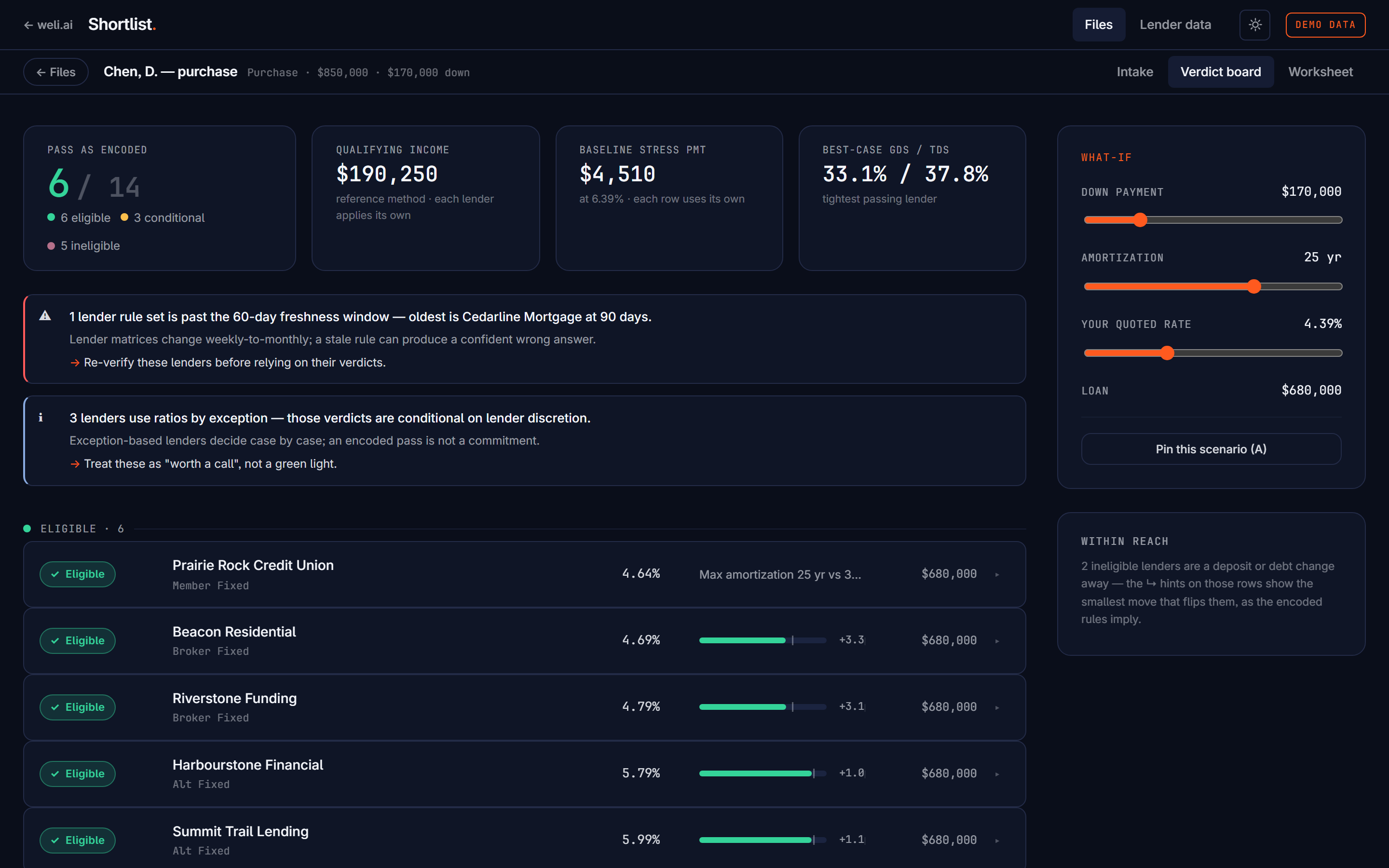
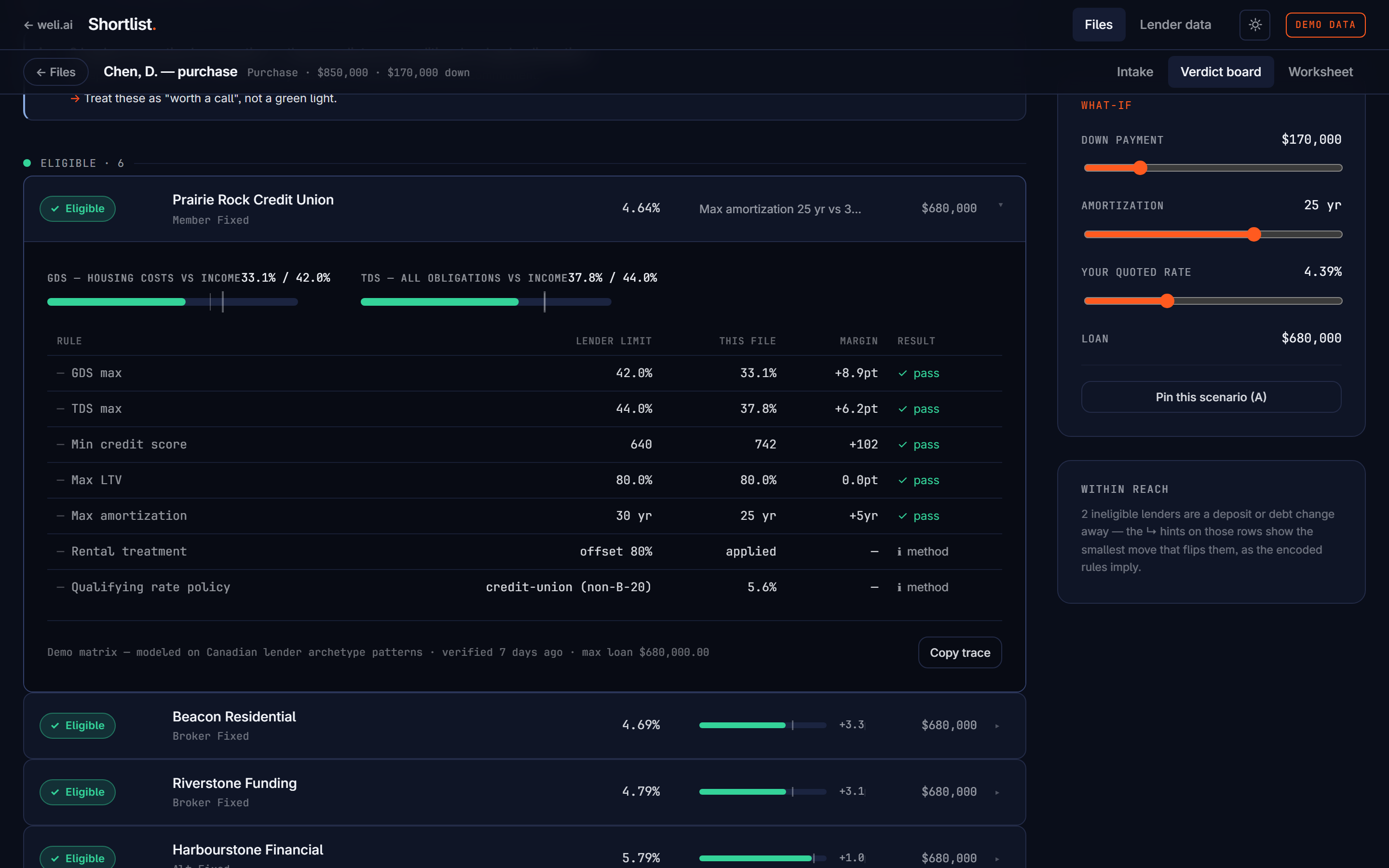
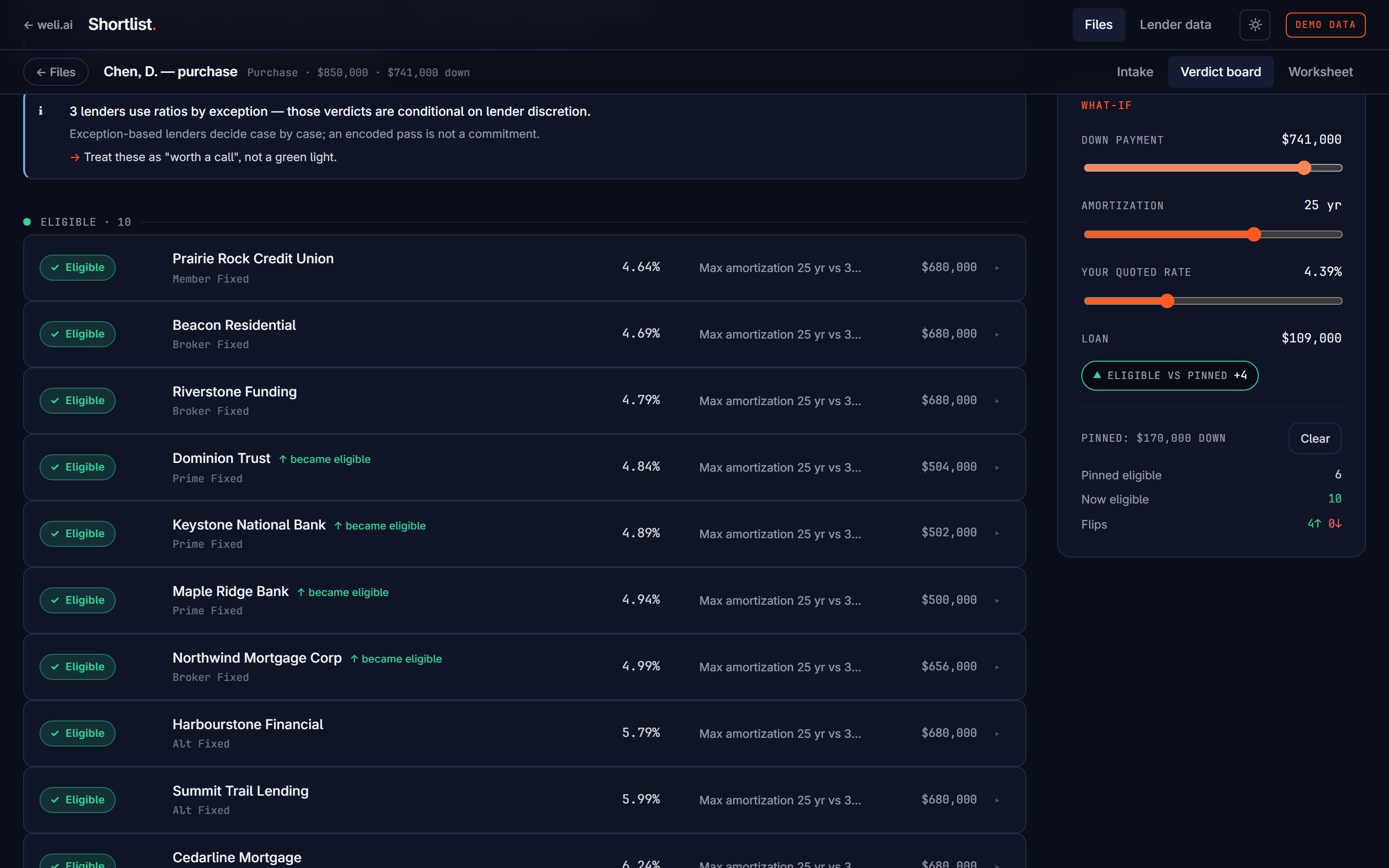
Every lender's answer at once: 6 eligible, 3 conditional, 5 ineligible, with the exact number that decides each.
Why bother
Submit blind and you burn lender relationships.
Submit blind and you burn lender relationships on files that were never going to pass, and you lose the ones you should have placed because the math was buried in a spreadsheet.
The checkable part
The adjudication is deterministic, lender-parameterized qualification math with citations and provenance. It computes the same way every run. The OSFI stress test is encoded as the greater of the contract rate plus 2% or 5.25%, verified 2026-07-08 against OSFI. Insured GDS and TDS limits are encoded at 39% and 44%. Every verdict traces to a rule, a limit, and a dated source, not to a language model's opinion. The rail recomputes the whole roster live as you change an assumption.
Honest note: the demo runs on a roster of 14 illustrative lenders modeled on Canadian lender archetypes, not real named institutions, and on synthetic borrower data. Shortlist is decision support for a licensed broker. It is never a binding pre-approval and never borrower-facing. The broker makes the recommendation.
The obvious objection
"I already know my lenders. I don't need software to tell me who will approve a deal."
Shortlist does not claim to approve anything. It shows which lenders pass the file as their rules are encoded, and the exact number that decides each one, computed the same way every time. On a self-employed or rental file across a dozen lenders, that is the math you would otherwise redo by hand, now with a trace you can hand to your E&O insurer.
When to use it
Mid-file, before you submit.
Deciding where to send
Mid-file, the moment you have the borrower's numbers and are deciding where to send the deal.
Before you submit
Before you submit to a lender, so you are not burning a relationship on a file that never passes.
A what-if
When a borrower asks "what if I put more down," and you want the whole roster to re-answer live.
Questions, answered
Plain answers.
What does Shortlist actually do?
You enter one borrower file, income by source, debts, and the deal, and Shortlist runs the qualifying income, the OSFI stress test, and the GDS/TDS ratios against every lender on the roster at once. The output is a verdict per lender: pass, conditional, or ineligible, at what rate tier, and the exact number that decided it.
Who is it for?
Licensed mortgage brokers deciding where to submit a file, especially on borrowers who are harder to place, self-employed, rental income, commission, or incorporated. It's a tool for the broker, not something a borrower would use directly.
Where does my data go when I try the demo?
Nowhere. Shortlist runs entirely in your browser and makes no network requests of any kind. When you enter deal details or import a JSON file, it's parsed and stored only in this browser tab's local storage, on your own device. Exporting a worksheet or JSON file just triggers a local download from your browser; nothing is uploaded.
Do I need an account? Is the demo free?
No account and no signup. The demo is free to open and try. Your borrower files stay in your own browser, and clearing your browser data clears them.
Does it use AI to make decisions?
No. Every verdict comes from deterministic, lender-parameterized qualification math, not a language model guessing at numbers. The OSFI stress test, GDS/TDS limits, and every lender rule are encoded values with a source and a date, and the adjudication sheet shows the rule, the limit, this file's number, and the margin between them for every line.
What does the lender roster actually represent?
The 14 lenders in the demo are illustrative, modeled on Canadian lender archetypes and typical rule patterns, not real named institutions or live rate sheets. The app discloses this in its own honest note. It's built to show how the adjudication logic works, not to reproduce any specific lender's current published rules.
How do I get this for my brokerage?
Book a 20-minute walkthrough and we'll go through it against a real file from your pipeline: weli.ai/contact.
Get started
Open the live demo.
Build a borrower, run the roster, and open one adjudication sheet to see the rule-by-rule math behind a verdict. The demo runs on synthetic data.
14 illustrative lenders, synthetic borrower data. Decision support for a licensed broker, never a binding pre-approval.