Lineup.
Read every offer right, minutes after the deadline.
Upload the competing offers. Lineup reads each one in your browser, shows you every term beside the exact words in the document, and flags the traps. You verify each field, then hand your seller a clean comparison.
ReaderEvery term read beside its source
Your dataStays in your browser
Read pathNo network, no LLM
You confirmEvery field
Watch it work
See a comparison come together.
90 seconds, real product, no slides.
The night you know
A single misread term is a five-figure exposure.
- 01
Offers land at the deadline and the seller wants an answer now, not in ninety minutes.
- 02
One offer has a conditional acceptance that would kill your backup offers, another has a two-hour irrevocability, a third says "7 banking days" and means something you have to check.
- 03
A single misread term is a five-figure legal exposure and a RECO complaint, and the most dangerous line to misread, the escalation clause, is the one written to be confusing.
Doing this by hand, fast, under a seller's eyes, is where the mistake gets made.
What it does
Every term, next to the exact words it came from.
01
Upload the competing offers.
Drop the PDFs. Lineup reads the text of each offer against the OREA form layouts, entirely in your browser.
02
Verify every field against the source.
Each extracted term (price, deposit, conditions, deadlines, irrevocability, closing, escalation clauses) sits next to the exact words it came from, with a confidence score. You confirm or correct each one. Nothing is trusted until you check it.
03
Read the comparison and the flags.
A side-by-side board with live irrevocability countdowns and plain-language risk flags: the conditional that kills backups, the short irrevocability, the ambiguous "banking days," the low deposit, the custom clause nobody read.
04
Hand your seller one clean page.
A branded, jargon-free one-pager with buyer identities stripped to "Offer 1," "Offer 2," and your own recommendation on top. It prints clean in grayscale.
Lineup does not pick the winner. It ranks by facts (price, escalation-aware potential, fewest conditions, closing fit) and leaves the recommendation in your words.
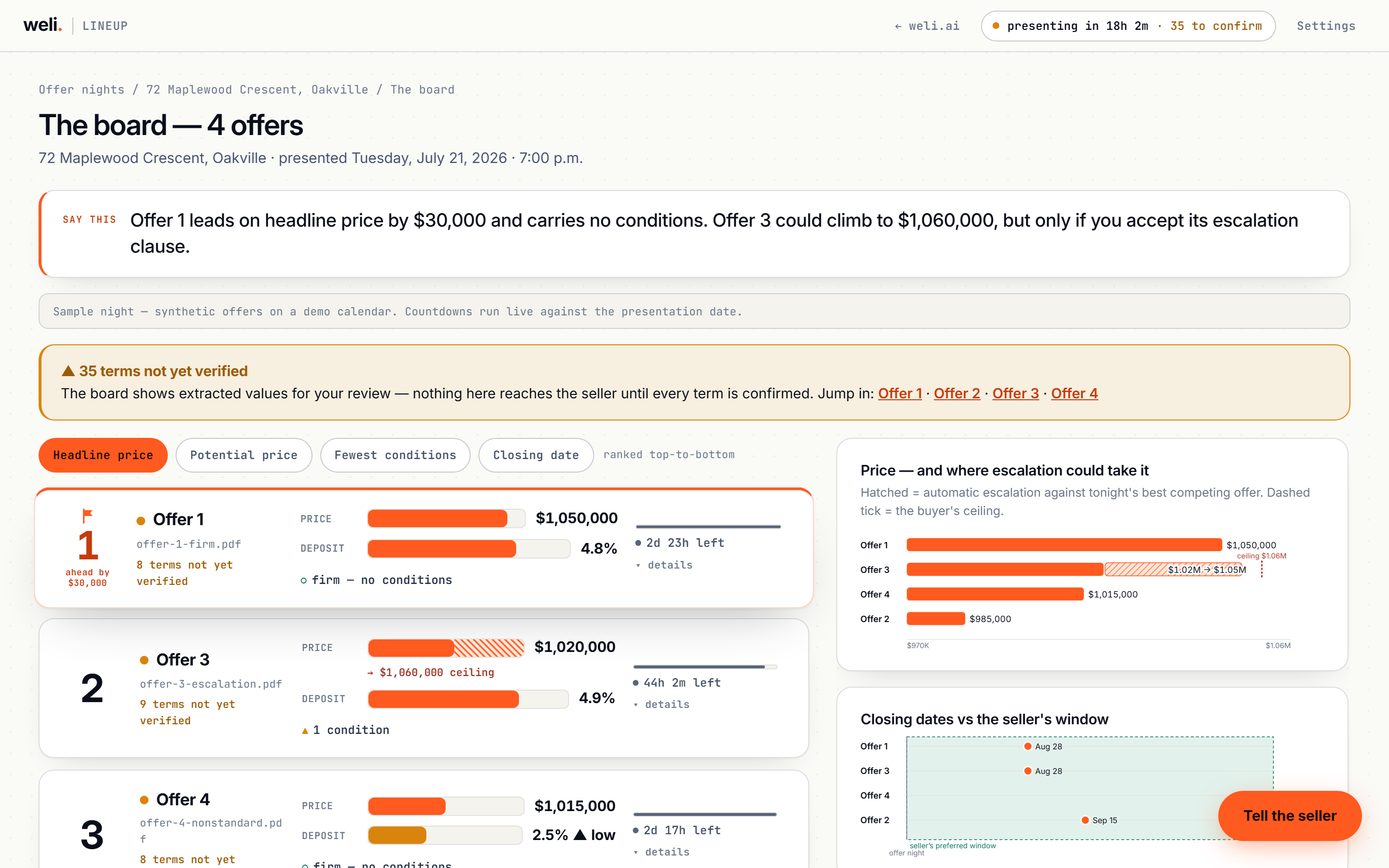
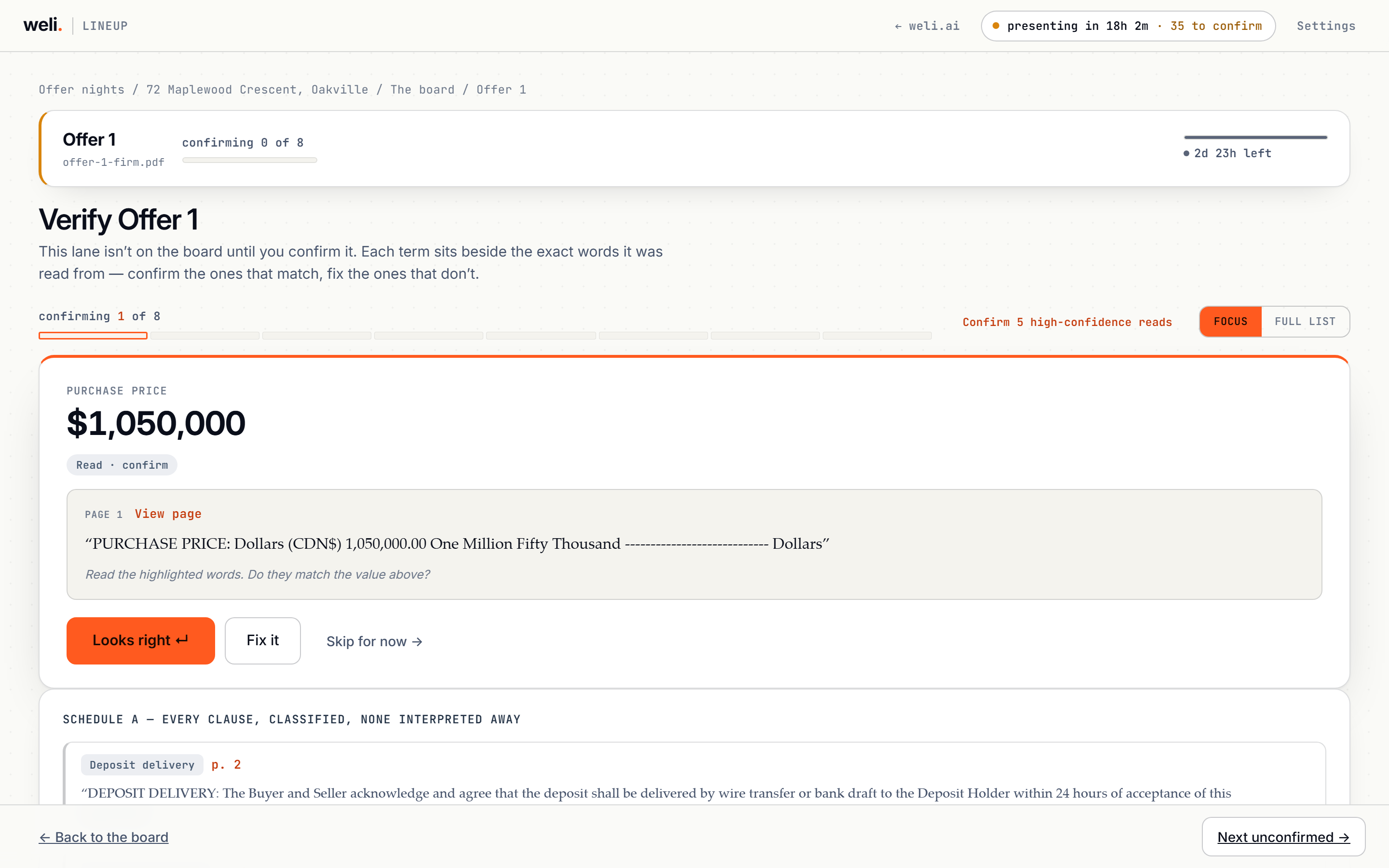
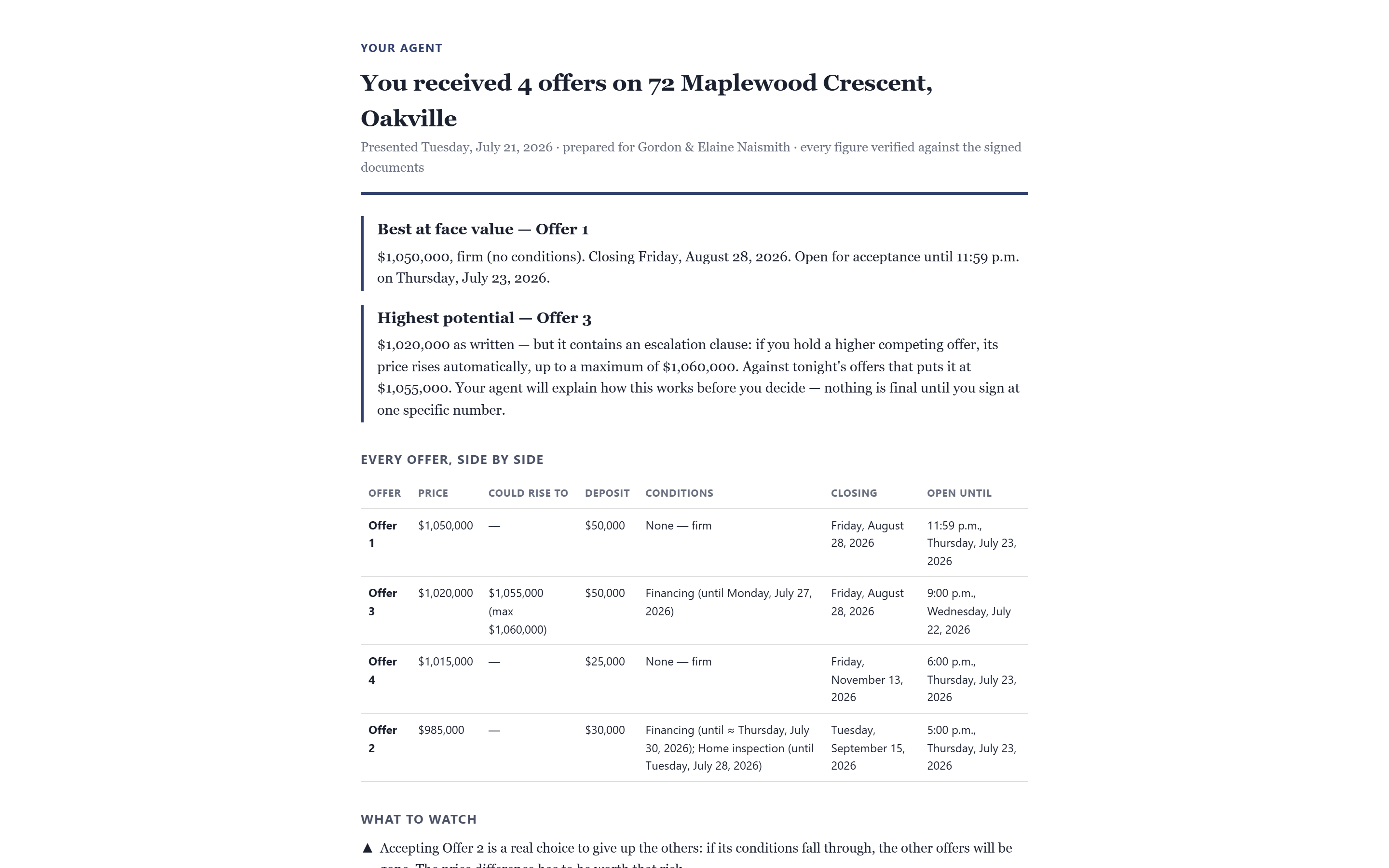
Four offers, ranked, with the seller-ready read already written for you.
Why bother
Get it wrong once and the cost is a legal file.
Do nothing, and offer night stays a race between your reading speed and a seller's patience, with a five-figure misread waiting in one of the PDFs. Get it wrong once and the cost is a legal file, not a lost hour.
The checkable part
The reader is deterministic with a 94-test suite, and there is no network and no language model in the read path. Same document, same reading, forever. Nothing leaves your machine; the offers stay in your browser. Uncertainty is shown loudly, not hidden, so you always know which fields to double-check.
Honest note: Lineup was calibrated on synthetic sample offers, not a library of real closed deals. It produces decision support for a licensed agent, not legal advice. The signed documents govern, and you remain the professional of record.
The obvious objection
"I already read every offer myself. I don't need a tool to do it for me."
Lineup does not read them for you. It puts every extracted term beside the exact words in the document and makes you confirm each one before it will build anything. It is a second set of eyes that catches the buried condition and the short irrevocability, so the read you already do becomes one you can defend.
When to use it
The night offers come in.
Offer night
The night offers come in, when several PDFs land at once.
The decision window
The minutes between the deadline and the seller's decision.
Any multiple-offer listing
Any listing where more than one offer is on the table and a misread term is on you.
Questions, answered
Plain answers.
What does Lineup actually do?
You drop in the competing offer PDFs from an offer night. Lineup reads each one and pulls out the terms that matter (price, deposit, conditions, deadlines, irrevocability, closing date, escalation clauses), lines each one up beside the exact words it came from so you can check it, then builds a side-by-side board and a clean one-page comparison you can hand to your seller.
Who is it for?
Ontario listing agents handling a multiple-offer night, where several PDFs land close to a deadline and the seller wants a fast, accurate read of what's actually on the table.
What happens to the offer PDFs I upload?
They never leave your browser. Lineup reads and parses the PDF locally using an open-source library called pdf.js, and both the extracted terms and the original file are stored only in your browser's local storage on your own machine. There's no server involved and no upload.
Do I need an account? Is the demo free?
No account and no signup. The demo is free to try. Your work stays in your own browser on your own device, and clearing your browser data clears it.
Does it use AI to make decisions?
No. Term extraction is a deterministic, rule-based reader built against the OREA form layouts, not a language model guessing at numbers. There's no LLM or external API anywhere in the read path, so the same document reads the same way every time.
What does it NOT do?
It doesn't pick the winning offer for you, and it isn't legal advice. It ranks offers by facts like price, escalation-aware potential, conditions, and closing fit, but the recommendation and the words you use with your seller stay yours. It was calibrated on OREA-standard forms, so a scanned, handwritten, or heavily customized offer may extract a field wrong, that's exactly why the Verify screen exists, so you catch and fix it before anything goes to your seller.
How do I get this for my brokerage?
Book a 20-minute walkthrough and we'll set it up on your workflow. Get in touch →
Get started
Try the live app.
Load a set of sample offers, verify the terms, and see the comparison your seller would get, minutes after the deadline.
The read runs in your browser. Outputs are self-contained pages that print. Decision support, not legal advice.